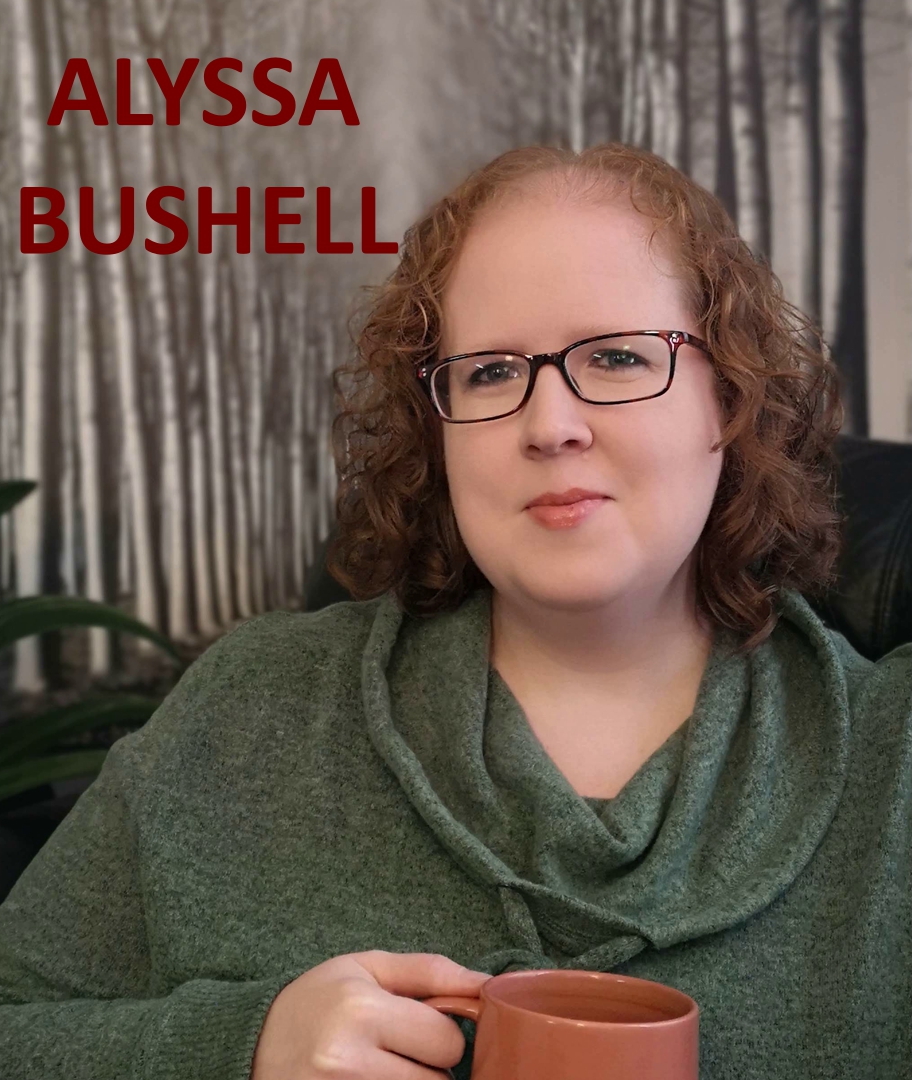
In this post, we’ll be hearing from Alyssa Bushell, mystery novel author, blogger, and baker. Alyssa is a Canadian writer located at Lake Huron in Southern Ontario. In this interview, Alyssa shares an overview of her story writing process, publication history, and some advice for fellow aspiring writers.
Pauline: Your fiction has been published in journals such as Reckon Review and LEON Literary Review. How long did it take before you started receiving acceptance letters for your work? And has publication changed how you view your own writing?
Alyssa: After I started submitting my work to literary journals, I had about six months of rejections before I had my first acceptance. I would say for every piece that has been accepted, I’ve had 8 to 10 submissions declined. My favourite piece of flash fiction I’ve ever written, a little story that has received rave reviews from my writing group and even praise from my ultimate goal publication, SmokeLong Quarterly, has been rejected no fewer than 12 times. That story still has not been published.
What I’ve learned is that choosing pieces for publication is a very subjective process. You can increase your chances of acceptance by sending the right piece to the right journal and carefully researching to familiarize yourself with what kind of work they publish. Ultimately, it is in the editor’s hands to decide what gets published, and any editor will tell you that they decline excellent work every day. Your piece may not work with the theme of the issue. Or they may have simply received an overabundance of quality submissions. Or the editor’s personal preference may not vibe with your story. Or your story may, in fact, not be quite polished enough yet to be published.
Most of all, I’ve learned as a writer to have a thick skin while also not being precious about my work. I once had a submission returned to me with the note, “This doesn’t function as a story.” Once the sting subsided and I looked at the piece again, that feedback wasn’t wrong. I guess what I’m saying is that to grow as a writer, I needed to get to a point where I could look at my writing objectively, from a distance, so to speak, and revise and edit without sentimentality.
P: What’s it like to write a novel manuscript? For a new writer, what sort of timeline and commitment does a novel manuscript require? Is this something that can, realistically, get finished in three months?
A: Speaking from the perspective of someone who is finetuning the umpteenth draft of my first novel, is it ever finished? Seriously, though, it is a PROCESS! I started writing this book in September 2020 and completed the first draft during my first NaNoWriMo in November 2020. So, I suppose the short answer is yes, you can churn out a manuscript in three months or less. I wouldn’t necessarily recommend having anyone read it at that point, but it can exist, and that is all kinds of exciting.
More realistically, it’s good to recognize that a draft will go through countless iterations before it becomes a polished novel. I completely rewrote that first hot mess in 2021. Then, I did a course offered by Writers’ HQ called Plotstormers and revamped my plot so it worked better. I’ve been editing and proofing and tweaking ever since while also drafting three sequels. I had a timeline in my mind for the final completion of Book 1, but life got in the way.
Every writer and every novel will be different. I think the key is to carve out a writing practice that works for you and your life circumstances. I am in a season of my life where writing has increasingly had to take a back seat to caring for my family, and that’s okay for now. I’m still showing up for my writing in modified ways that work for my current situation. And therein lies the key to sustainable commitment: show up + be reasonable.
P: From time to time, it is natural for writers to experience a creative slump. What advice do you have for fellow creatives who may be feeling inadequate or have low motivation?
A: I wrote a piece for my blog a while back entitled “How to Keep Writing When You Feel Like Giving Up.” I still stand by the ten suggestions in that article, particularly the idea of taking a deliberate break. A break can take many forms, and it doesn’t necessarily mean not writing. “A change is as good as a rest,” right?
When I feel like I’m in a slump, I often change what I’m writing. If my novel has me banging my head against the wall, maybe I’ll turn to a quick piece of flash. If I hit a roadblock in my story, I’ll skip forward and write a scene that I’m excited about instead. But if changing it up isn’t working, don’t be afraid to take intentional time away from the process. There are many ways to refill that creative well.
P: When you’re creating a fictional character, how do you go about deciding what goes into that personality? Do you have any go-to techniques for developing complex and layered characters?
A: I do a lot of quirky character-generating exercises. Sometimes, I’ll write a short vignette from the point of view of a character I’m workshopping. There’s another one where you picture your character walking into a room for the first time. How do they introduce themselves? How do they react to what they see? What kinds of things do they notice?
Another one is to throw the character into an awful situation. What are they like when they experience strong emotions? I also love the much-used question: what is in your character’s pockets? And I often make a Pinterest board for a character or work in progress where I can pin the general vibe, clothing choices, etc.
Every character has to want something, but they should also deeply need something, and if the thing they need is in conflict with the thing they want, you’ve got a story. With that in mind, I also like to play around with how a character views themselves as opposed to how others see them. We all have that interplay between our own inner narrative and our outer persona as perceived by those around us, and creating that for fictional characters is what provides those deeper layers.
It helps to people-watch when you’re out and about. If you spot a quirk or mannerism, make a note of it for future use. That’s a great way to capture bits of found dialogue that you can work into a story later, too.
P: How many times have you participated in NaNoWriMo? What was it like? Did the process help you make any unique writing breakthroughs? Will you be participating in NaNoWriMo again in the future?
A: I have done NaNoWriMo four times and have dabbled in Camp NaNo (the pared-down version that happens in April and July). As a result, I have drafts at varying levels of completion for four novels. For me, shutting down my inner editor and forcing the story out onto the page rapidly and messily is exhilarating.
I enjoy the sense of community it fosters, working towards a common, if ludicrous, goal. I like challenging myself, just for 30 days, to make churning out words my top priority. Online events like the Global Write-In Crawl and One Hundred Hours of Writing make November a highlight of my year (both of these events are run independently of the NaNoWriMo organization). The gamifying of writing in this way is particularly effective for me when I have a new idea and want to quickly spew out a draft so that I have something tangible to shape into the story I want it to be.
This approach does not work for everyone. And all that being said, the NaNoWriMo organization itself has been the centre of some disturbing controversy, and it remains to be seen to what extent I will choose to be involved in the future.
P: Is there anything else you’d like to share or promote?
A: Writers’ HQ has been absolutely invaluable in helping me grow as a writer. They’re running Write a Novel Month in June, and I can’t sing their praises enough. Check it out!
And I’ll also throw in some self-promotion: My story “Not All Sparks Start Fires” is featured in the collection Small Town Summer Nights along with seven other Canadian writers, which is available through Chicken House Press.
And finally, don’t hold your breath, but look out for the first in what I intend to be a series of cozy mystery novels. Sneaking Suspicions follows “almost” pastry chef and aspiring author Amber to a weekend writing retreat where she works to solve a murder that no one else believes has happened. As Amber tries to justify her suspicions, the other guests are covering up secrets of their own.
Read Alyssa Bushell’s blog at AlyWrites.ca
Find Alyssa on social media: @WritesAly on X (Twitter) and Instagram

