Resources & Blog Posts

Interviews

Check-in with Chris Sadhill

We’re checking in with writer Chris Sadhill. In this post, he sums up what he’s been up to, outlines the evolution of his writing journey, and shares frustrations with which many creatives can relate.

Take a look at his author bio:

Chris Sadhill is an evocative writer and poet whose work dissects the human experience from the fringe. His writing is recognized for its meaningfully layered hybrid of in-your-face and nuanced beauty, often exploring life’s darker realities. His stories have been described as powerful, reflective, and artfully woven, featuring deeply flawed and fractured characters burdened by struggle.

Sadhill has been published in Querencia Press, SFS Publishing, and most recently Seton Hill University’s Eye Contact Magazine. He is a multi-award-winning poet and short story writer, with numerous recognitions across national and international competitions, including Elegant Literature.

He resides near State College, Pennsylvania, with his wife, two cats, and their Mini-goldendoodle, Winston.  
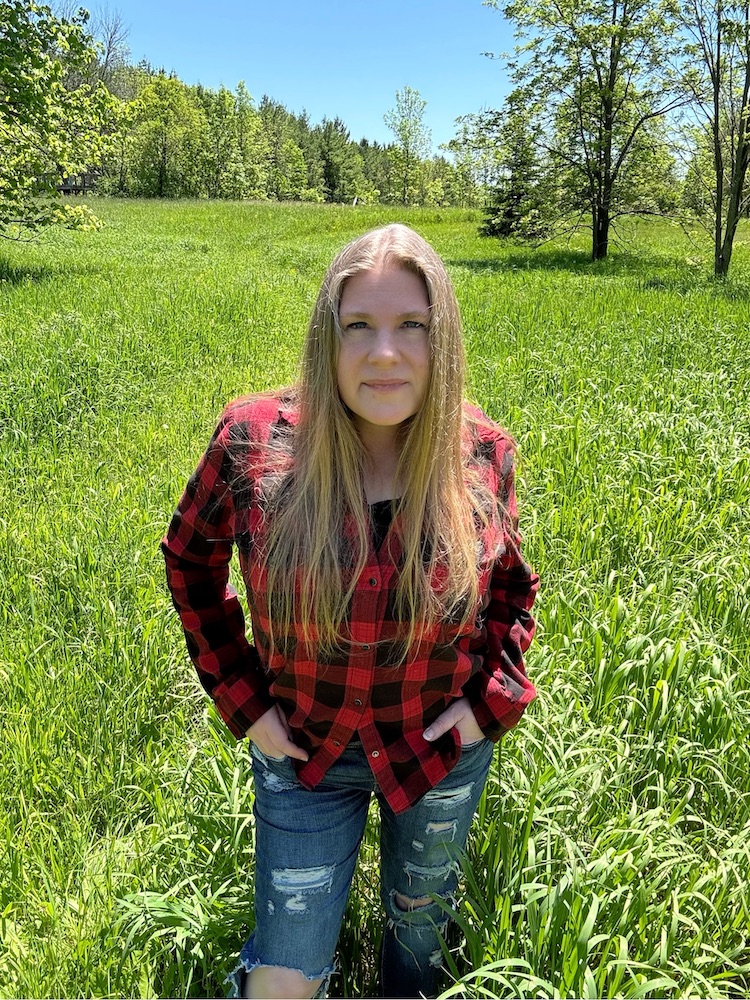
Photographer: Chris Sadhill’s wife, Brandee

Chris! It’s been two years since our last interview. What did 2025 look like for you in terms of writing projects & new developments? What’s on the horizon for 2026-27?

Now, this is a loaded question—one I’ll try to peel apart like an onion, but only briefly.

Briefly because I’d rather not rehash what was already incinerated and left behind me to smolder. And much like an onion, 2025 leaves a certain pungency that lingers long after the peeling and chopping—and, for a select unnamed few, a raging river of tears.

Hearing that it’s been two years since our last interview invokes a mild but temporary depression. My inner voice immediately starts screaming: You fucking loser, get on it. Why haven’t you written that novel yet? Two goddamn years? What the hell are you waiting for? Are you even a writer?

Clearly, my inner voice isn’t very friendly.

It’s funny how, in retrospect, we only understand certain truths once enough time has passed. Reality has a way of revealing itself long after the moment has ended.

Continue reading “Check-in with Chris Sadhill”
Interviews

Interview with San Qing

Get ready. This post will BLOW YOUR MIND. I do not use that term lightly.

Taoist Master San Qing agreed to answer many deep questions right here in this blog post. He has also shared a Rhapsody, transcribed from Lao Tzu. Clear your schedule for this one. And enjoy the ride!

San, what inspired you to publish your e-book Tao Te Ching Magical Register?

Inspiration is more like exhilaration, an understanding that everything along my life path has always been a divine spark of energy. It arrives the moment I pause, take a breath, and open myself fully. The Tao, the teaching, the magical register is a direct communication between myself and my teacher Lao Tzu: an unconditional stream flowing from an ethereal space. I like to call it slipstreaming. It creates, propels, and prepares you for what most people would consider a surge of motivation; a feel-good, inspiring moment. It grants me creative license to generate something powerful.

Yet, to be honest, my roots run so deep, they are anchored far beyond this lifetime, extending through many incarnations. Bringing me back to what feels so profoundly familiar is the natural selection, the natural order of the Tao. And the Tao, the teaching, the magical register, is spoken word from my immortal ancient teacher to me, through me as I serve as catalyst and conduit. I transcribe every word, creating what I consider, and what everyone who walks the path of Taoism comes to know, as a living scripture.

How did you prepare for a writing session while working on this project?

For this literal masterpiece arises far more from my ancient roots, my natural passion, and my deep desire. My divinity exploding through me as this instrument and tool to create and bring forth this lifelong teaching. The preparation itself was easy. Yet the sacrifice and surrender that was necessary was not preparation. They were not anticipation, they were natural, they were effortless, and the creative spark shone through me as I transcribed every word.

What helped propel you forward to finish it?

To be blatantly honest, there is no need for creative license. Nothing motivates me more than to wake and meet the dawn of a new day, and nothing fills me with greater excitement than to lay my head down as dusk rings in. This force, this intimate relationship with what we call the Primordial Mother, the Wuji, the holy stream, can only arise from complete surrender and unconditional blind faith.

I watch the next moment unfold without any anticipation or expectation. I was born to breathe in, emanate, and walk this path. And it is precisely the solitude that comes from humility where my attention lies; my desires are secondary. My surrender is absolute. My service is forever.

Which is your all-time favourite superhero character? Why?

Continue reading “Interview with San Qing”
Interviews

Interview with Jeff Evans

In this inspiring and informative post, we’ll be learning a lot from videogame designer Jeff Evans. He tells us about his passion for gaming, describes his current project, and offers advice for new creators.

About Jeff Evans:

Evans is a lifelong gaming enthusiast and entrepreneur. He started creating board games at an early age and transitioned that passion to computer games in his early teens. In 2003 he began creating video games professionally and in 2008 he combined his two passions together and started his first game development business called Antic Entertainment. Since then he has created 2 other video game businesses (Tiny Titan Studios and Doom Turtle), a Games and Hobby retail store with 2 locations (Mana Lounge) and a Pinball Shop and Arcade (Mana Pinball).

Jeff, when you were hired to work on Battlefield, did you have an inkling that this could spark a career path in video game design? At what point did you decide to venture out on your own as an entrepreneur?

I’ve wanted to make games ever since I was young. I remember writing ideas down on a letter, putting it in an envelope that I wrote Nintendo on and stuffed in the mailbox, hoping they would one day make a game like that. I didn’t even have a stamp or address on it. Woops. I was in Waterloo at the time I found out about Digital Illusions in London. I reached out, performed an art test and was hired within the week. It was a pretty exciting turn of events.

While I worked for a few companies I knew I always wanted to make my own games and in 2008 I took the chance at my first studio. Since then, I created a mobile studio called Tiny Titan Studios, and most recently Doom Turtle, where we focus on quality premium indie titles.

How long does a video game such as Ember Knights take to go from concept to market? Tell us about your source of inspiration. What helps you push through when a project seems stuck or impossible?

Video game production can be a strange thing with many variables to consider. The overall development time can be months to years depending on all the features and scope. With Ember Knights, it actually started as a completely different project on mobile.

Continue reading “Interview with Jeff Evans”
Interviews

Check-in with Alanna Rusnak

In this post, we’ll be hearing from writer, editor, and publisher Alanna Rusnak. She updates us on her writing and publishing projects, while also offering us a glimpse into her inspirations as well as challenges. If you missed our original interview, take a look here: Interview with Alanna Rusnak

Check out Alanna’s author bio:

Alanna was born in the wrong decade and dreams of abandoning everything to live in a van and travel across Canada. She’ll call it “a book tour,” but it’s really an excuse to unleash her inner hippie.

A collector of typewriters and John Travolta VHS movies, she believes life is too short to not indulge in the things that bring you joy and in keeping with that philosophy, she left a stuffy office job of 18 years to launch a full-time indie press out of a chicken coop on her childhood property.

An author of literary and speculative fiction, Alanna likes to play in dark spaces, but always leaves room for redemption. Her latest novel is about burning down the world in order to set things right.

Settled in West Grey as a four-year-old, it has always been her home and source of inspiration and she’s working hard to build bridges between the various arts communities. With no immediate plans to abandon this, she will certainly leave it all behind the moment her husband gets on board with the van-life idea.

Alanna it’s been two years since our last interview. What did 2025 look like for you in your multiple roles as a writer, editor, and publisher? What’s on the horizon for 2026?

It’s actually hard to look back and articulate everything that happened in 2025 because the publishing world requires eyes forward at all times. As a solopreneur, I am keeping many balls in the air and though I’m always tired. I’m also always invigorated by the exciting projects that are constantly on the go.

I made a big decision in 2024 to keep my submissions closed in order to nurture my existing roster, roll out the titles already in my queue, and focus on follow up titles from writers already in my catalogue. This has been a game-changer in terms of workload and time management. I was working on an unsustainable (but totally exciting) publishing calendar that demanded a title was released every month. From a financial standpoint, this makes sense; from a human perspective, something had to give. The de-escalation has given me space to more fully invest in myself as a writer, and I learned that I have to treat myself like a client in order to find a good balance.

Now that we’re in 2026, I’m just beginning to see the effects of that 2024 decision. And as things are feeling more manageable, I’m able to push out titles with more care and discernment.

Who are your mentors or role models in the business? Tell us about one person who has inspired or supported you in your journey as a publisher.

I love following other scrappy little indie outfits who, like me, have a heart for writers and a desire to see them succeed. I’ve built a nice relationship with the owner of Byzantium Sky Press out of Delaware and we are often trading tips and tricks back and forth, commiserating over AI, and celebrating one another’s accomplishments through emails, Instagram DMs, and Zoom chats. It’s refreshing to find people who don’t look at you as competition, but as comrades in the same battle for creativity.

Chicken House Press is a flurry of activity! Alanna, tell us about your authors’ forthcoming appearances and readings. How can interested readers support their work?

Continue reading “Check-in with Alanna Rusnak”
Interviews

Interview with M.C. Joudrey

In this post, we’ll be hearing from M.C. Joudrey. He tells us about his sources of inspiration, shares networking advice for new writers, and drops a few hints about his work in progress. Check out his bio:

Image courtesy of M.C. Joudrey

M. C. Joudrey is an award winning Canadian writer, artist and designer. His second novel Of Violence and Cliché was released September 2013, followed by his collection of short stories Charleswood Road: Stories in August 2014, which was nominated for a 2015 John Hirsch Manitoba Book Award. His novel Fanonymous was released in 2019 and won the Independent Publisher gold medal for best work of fiction for Western Canada. It was also nominated for two Manitoba Book Awards, including the Margaret Laurence Award for best work of fiction. His forthcoming novel Marmalade Parade (Guernica Editions) releases May 2026. As a designer, his work has been awarded four Alcuin Design Book Awards and the Manuela Dias Manitoba Book Award for Design. He is also a bookbinder and a number of his works are held in galleries internationally.

Matt, you’re not just a bookbinder—you’re a bookmaker! You design and print books as well as do the layout in addition to the actual binding. You’re also known for using unconventional materials, such as stained glass, in this process. Tell us about your most ambitious bookmaking project to date. What sort of considerations went into the design and materials used?

I’m thinking about a book we are just starting to work on. I can’t say much, but it will be the most ambitious project we’ve done to date. What I can tell you is we will be taking our time with this one. It’s going to take a couple of years to see it to fruition. It will be challenging, to say the least, but exciting.

What inspires your book designs? Who are your mentors or role models in the business?

Everything is considered as inspiration. Magnificent things and trivial things, inanimate and alive, colour and halftones, sounds, smells, great design, bad design. It all inspires in some way. There’s no single person who serves as the bulk of inspiration, rather, an individual work that is scintillating, so much so that it shines without the sun.  

In addition to creating and designing, you also write! What does your average day or work week look like? How do you find balance with so many roles to fill?

I don’t. I haven’t slept in 20 years. I’ll run until there’s no wax left.

Matt, you travel a fair amount, attending events such as the Frankfurter Buchmessein Germany. What books do you pack when flying? And do you read ebooks?

Continue reading “Interview with M.C. Joudrey”
Interviews

Interview with Dani Arieli

In this highly energized post, we’ll be learning a lot from writer, editor, and publicist Dani Arieli. She tells us about her passion for poetic language, describes her current work in progress, and offers heartfelt advice for new writers.

Check out her author bio:

Photo Credit: Nieram Arieli

Dani Arieli is a poet and author, Pushcart Prize nominee, and lover of weird, dark, and archaic literature. She has creative works featured in 7th-Circle PyriteBeyond WordsLothlorien Poetry Journal, and more. She is the marketing and publicity specialist for At Bay Press, and is currently working toward her Honours Bachelor of Creative Writing and Publishing degree at Sheridan College.

During most writing sessions, her black cat sits atop her lap while she fervently taps away at her keyboard; she very much enjoys having a writing partner who can meow.

Dani, a Pushcart Prize nomination is a big deal—congrats! How did you process the nomination news and has this changed how you view your own writing?

First of all, thank you for the kind words of praise! When I received the E-mail detailing my nomination, I can tell you right now—I practically froze. I was in sheer disbelief, as the story which had been nominated, Across the Marsh, was my second-ever short-story publication, as well as my first-ever online publication. Of course, with this nomination, came the rather terse realisation that this is now the bar. So, with my current W-i-Ps—be it short-story or manuscript—I find myself constantly, and rather erratically, poring over my writing as I convince myself this, too, is Pushcart-worthy… And hopefully, they are! But, the pessimist in me says otherwise. All I know is that my life’s purpose feels tied to usurping this bar.

At what point did you realize you had a passion for poetic language? In what ways did your coursework at Sheridan College help you move forward to pursue writing as a career? What additional supports did you have along the way?  

Two words: My professor. I entered into my first-ever Poetry class/seminar in my early years at Sheridan College, and I knew nothing about the art of poetry. When I first presented my ‘poem’ to my professor, I was ready to listen to some minor substantive edits regarding syntax and word choice; but when my professor began to point out the facets of my poem that were, really, there without rhyme or reason (why did you choose to centre your text? why is this section in italics? is ‘purple’ truly the only way you can describe this object?), it became quickly apparent that my poem was simply… words. These selections from the English language did not occupy a rigorous or intended place within the poem! So, I began to think about ways to describe certain feelings, thoughts, ideas, people, places, struggles, desires, fears, depravities—until the abstract and subjective nature of my musings began to spread across the page like blood from a slick lesion. Now, and especially in my manuscript, I find myself resorting to poetic language when describing exposition; and, speaking of my manuscript—as I am writing from the depraved and infamous mind of France’s notorious sadist, the Marquis de Sade—poetic language seems only fitting for such mad musings. There is a haunting beauty in the poetic language, and my professor helped me realise this during that single class at Sheridan.

Continue reading “Interview with Dani Arieli”