

In this post, we’ll be hearing from Canadian author Jack Stilborn. Check out his bio:
Jack Stilborn lives in Ottawa, Canada, and writes fiction and short stories. The Tyranny of Good Intentions, his debut novel about love, death and a great deal of politics on a condominium board, is now available from Chicken House Press.

He showed early promise with a comic story that made a cousin laugh so hard she threw up. He was then deflected by studies (double major in political science and English literature at the University of Saskatchewan; politics and philosophy B.A. at Oxford University; PhD. with dissertation on the thought of Alexis de Tocqueville at Western University). After that came life as a policy research analyst (Parliament), intergovernmental affairs advisor (Ontario government) and public servant (Ottawa). He also enjoys cycling, kayaking and (recently) cold water swimming; family life (Alex, Jessica, Christine and partner Linda); participating on volunteer boards and lots of reading, especially literary fiction and history.
Jack, tell us how the concept for your debut novel The Tyranny of Good Intentions came about. What helped propel you forward to finish the manuscript?
I have served on several condo boards of directors, as well as other volunteer boards. I started doing this while still working on my long-term day job as a research analyst working for Parliament (federalism and parliamentary governance issues). At a certain point, the light went on and I realized how much of national political life is captured in relations and behavior on these smaller boards. I was propelled forward because writing was a pleasure for me, perhaps an escape. Also by curiosity about how Andrew, the protagonist, would deal with challenges that are part of democratic citizenship.
The novel’s protagonist, Andrew Walmer, suddenly finds himself roped into a microcosm of our own societal landscape. What difficulties did you experience while constructing the plot? Did you have doubts while writing the draft?
A general problem that I had was trying to keep the main narrative (Andrew’s struggle to escape the condo board) in balance with the two sub-plots (repairing his marriage, keeping his job). At times I felt the sub-plots were threatening to take over, because each is interesting in its own right. I also considered a range of futures for Andrew, from losing both job and wife to, possibly, going into politics himself. As he became a more defined character, his personality and circumstances seemed to dictate what would happen.
Andrew proclaims himself to be an excellent judge of character. Translation to the reader: strap in, buckle up, and brace for a wild ride. You’ve been diligent in designing fictional characters who all exhibit their foibles as the plot moves forward. What challenges did you have in creating these characters? How did you keep tabs on each unique character’s development?
Andrew is not the most reliable of narrators, starting with his misreading of a neighbor in chapter one. This freed me from having the actions of other characters dictated by Andrew’s impressions of them, and allowed them to respond to situations as they arose, sometimes catching Andrew by surprise. I enjoyed writing these surprises as they happened but, of course, had to make sure that they happened within the constraints of the overall arc of the narrative. Some of the secondary characters are hybrids of people I have met over the years, and not just on boards. Others magically appeared when the plot needed them.
Tell us the story behind the book’s title, The Tyranny of Good Intentions. At what point did you brainstorm possible titles and how much say did you as the writer have over the final selection?
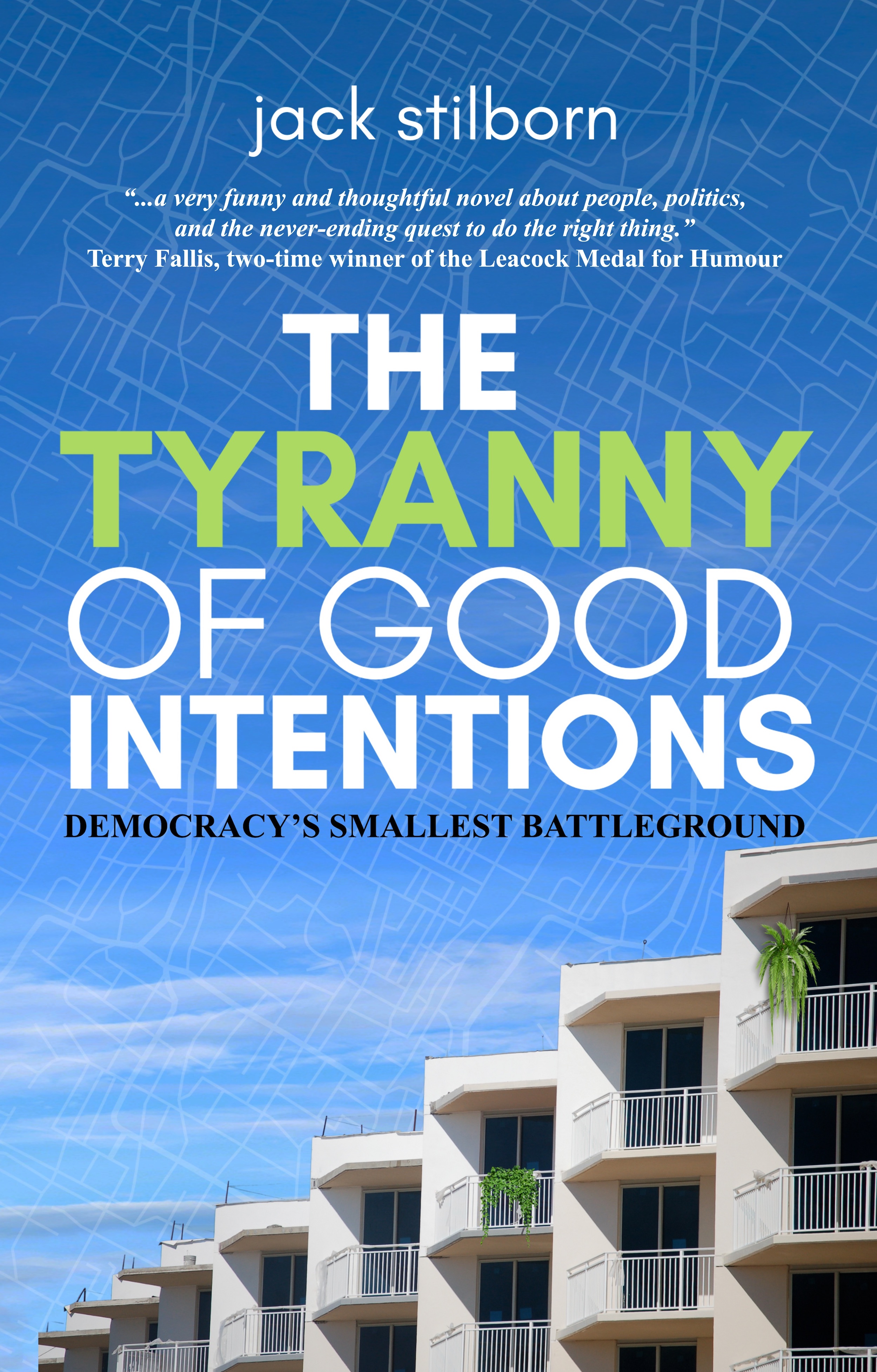
I like to think from the general to the particular, and the story of the title would be an example. The title came to me as a somewhat abstract thought about how convictions about the goodness of one’s intentions can blind a person to what they are actually doing and to its impacts on other people, and thus preclude self-doubt or careful thought. The condo board is a continuing illustration of this, but several individual characters in the story also become aware of similar dynamics in their personal lives. My observations about some real-life boards gave me the thought, but then I began to see this relationship in many areas of life. I didn’t brainstorm about possible titles; this one was in my mind from day #1 and Alanna Rusnak of Chicken House Press liked it as well.
Until delving into your manuscript for The Tyranny of Good Intentions, you wrote non-fiction, including doctoral-level academic papers and a published op-ed. Did you have any inkling your interests could evolve into writing fiction? At what point did you begin to take the idea seriously? What supports did you have along the way?
It was actually the other way around, historically. I have always enjoyed writing stories, and stumbled into satire in Grade 12 with a story about God returning to inspect the planet He had created, and giving special (and very scathing) attention to the Saskatchewan educational system, especially high schools. With several lengthy interruptions, I have been dabbling at writing fiction for most of my life, although much of this went into the garbage where, I have to say, it belonged. Encouragement in a university creative writing course, and some publishing in a student magazine, didn’t make the idea of turning the writing of fiction into a career seem practical to me. I knew that I would worry about its financial uncertainty, and felt that this would destroy my enjoyment of writing. I also think that it is valuable for any writer to have experience beyond the world of writing, experience that can be explored in the writing.
Tell us about the Ouroborian Book Society. What tips can you offer to someone who may want to start a book club?
The OBS is a non-fiction book club that has now been discussing a very wide-ranging menu of books for almost 12 years. It has made me aware of many books that I would never have known of, as well as many books that I wouldn’t have considered reading. However, it’s often the book one has no interest in that turns out to be the most broadening. Other members often express gratitude for the stimulation the club provides, both in the reading menu and in its monthly discussions. The most important tip I can offer is that any club will be the creation of the people in it, so the selection of the people who start the club is crucial. I think people who read a lot, get along with each other, have diverse reading interests and a delight in discussion can be especially valuable, both as members and as recruiters of additional members.
Jack, you’re writing short stories. Tell us about your current work in progress.
The ideas for the stories often come to me when I’m reading the morning paper, remembering a moment that mysteriously remains vivid, or looking out my office window and daydreaming. Recent stories have explored why we value human life (a ferocious competition among gardeners to grow the prize-winning pumpkin threatens to turn violent); or authenticity (a politician realizes this is now the key to re-election and asks his therapist to help him perform himself). I’m now exploring the possibility that personal identities based on family history are really projections of present needs and experience (a girl feels her father’s celtic ancestors in her blood, but isn’t aware that her parents relied on a Polish sperm donor for her conception). I never know what the next one will be, which is part of what keeps me doing this.
What inspires you? What strategies do you use to ensure that you can approach your writing with enthusiasm?
I live a calm and predictable life, so I enjoy thought experiments, and resulting stories, that are unpredictable and challenge my ideas. I don’t really have a strategy for bringing this about, apart from ensuring that I have plenty of time to let my mind wander, and plenty of reading about human experiences that I will never know directly.
Jack, do you have a go-to method for naming your fictional characters?
I don’t really have a method. The names often respond to situations and needs the story has generated. For example, Andrew Walmer’s name is deliberately ordinary, enabling him to be a kind of everyman. Eventually, I realized that he shares his name with Walmer Road in Toronto which, to my knowledge, is an entirely ordinary street. In contrast, the name of his wife Francine Antoine was the product of research on the names of Jamaican slave families who eventually emigrated to the U.K. (which is her family background). Still other names simply pop into my head without any careful thought and just seem right. Sometimes this can be awkward. For example, Bobbi (one of the dogs in the story) has the same name as one of my cousins. I have reassured the cousin that Bobbi is a very nice dog, definitely the nicest dog in the book. Happily, family problems seem to have been avoided.
Truly good satire requires a sharp wit and an appreciation of the wider scope of human behaviour. These days, however, it seems humour writing is a hard sell. What gave you the confidence to employ satire in writing your novel? What advice do you have for writers working on pieces that may contain satirical elements?
It’s true that reality is giving satire intense competition for absurdity these days. But maybe this has always been the case. It just means satirists have to up their game to stay competitive. My test is that if an idea intrigues and amuses me, then it will be fun to try to bring it to life in a story. I don’t try to figure out what other people might like but, when I’m writing, I spend a lot of time trying to make the writing communicate effectively. I feel it would be presumptuous to offer other writers advice, but maybe they might find this approach helpful.
Jack, what’s the most unexpected comment or suggestion you’ve received on your own work? How did it help you grow as a writer?
A friend (who is still a friend) gave me a very short review of a previous novel (that almost certainly will never be published). “Boring,” his review said. This helped me to grow by becoming more careful about who I ask for opinions.
Who are your all-time favourite authors? Which books do you recommend checking out?
I am a very eclectic reader and, as a result, I have a long list of authors who cannot really be compared to one another, but who are wonderful in distinctive ways. I worship at the feet of George Orwell, and I recently enjoyed Dorian Linsky’s excellent The Ministry of Truth, which tells the story of the writing of 1984. I also worship at the feet of various classical authors, notably Dostoevsky, Dickens and fathers of satire such as Jonathan Swift and Laurence Sterne. Then there are the delightful eccentrics, such as Robert Musil (A Man Without Qualities) or Elias Canetti (Auto-da-Fe). David Foster Wallace wrote an exquisite portrait of boredom within the U.S. Postal service (The Pale King) and, more recently, George Saunders has written brilliant short stories, and Margaret Atwood’s The Handmaid’s Tale is beautifully written in addition to providing a compelling dystopian vision. Recent reads that I’ve enjoyed include Tom Rachman’s The Imperfectionists, a delightful portrait of life inside a dying international newspaper chain, and Robert Coover’s short stories, which take the short story to places it hasn’t gone before. I could ramble on indefinitely here because there are so many wonderful writers. What I value above all is originality, and all of these have it in spades.
Writing is generally regarded as a solitary pursuit, but no writer can truly succeed alone. Tell us about the social and networking opportunities that you’ve participated in recently. What advice do you have for new Canadian writers who may be feeling isolated or intimidated by the wider writing community?
I enjoy meetings of my Canadian Authors group of Ottawa writers, not only for insightful criticism but also for frank discussion of challenges in their own writing. I also value a small group of friends with whom talk about books is ongoing, and comments from Linda, my wife, on my writing. The best advice I can offer is know thyself, including what you need and then put together the kind of support network that will work for you. Having said this, I think there are limits to what support can accomplish because, at a certain point, it may dilute the originality of an author’s voice.
Is there anything else you’d like to share or promote?
I think writing is beneficial because it compels careful attention to words, and that feeds back into more careful attention to thoughts. So I’d like to promote that for anybody who isn’t doing it already. There is ceaseless pressure against precision of language in our culture, and I think we all need to love and care for it more.
Have someone in mind for an upcoming interview? Want to know more about an author or publisher? Start the conversation by commenting below. Like what you see? Remember to subscribe to have future blog posts delivered to your inbox.
Cover Image: Photo by Monica Silvestre on Pexels.com

 Pauline Shen
1 thought on “Interview with Jack Stilborn”