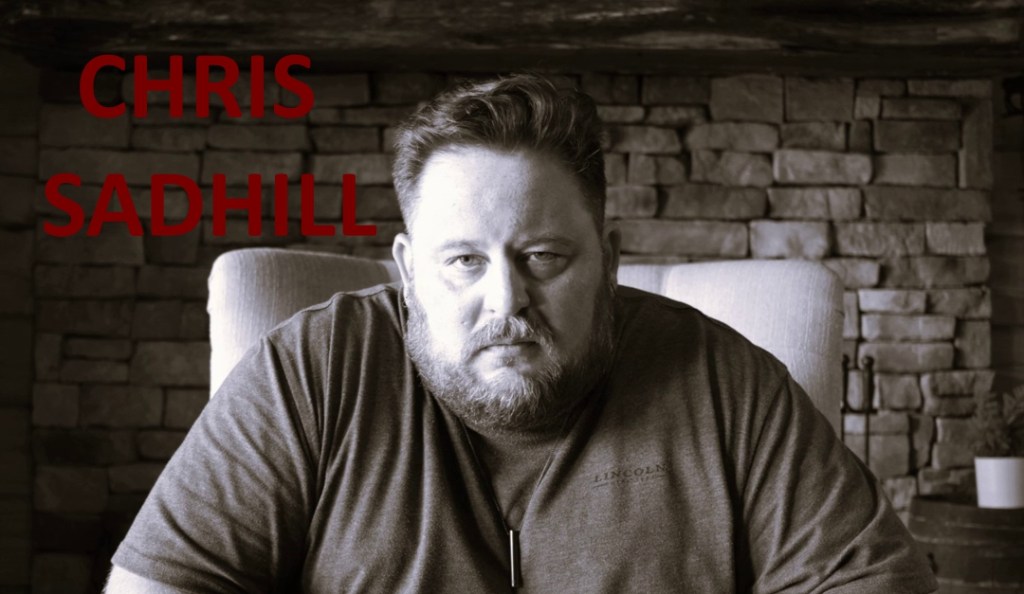
We’re checking in with writer Chris Sadhill. In this post, he sums up what he’s been up to, outlines the evolution of his writing journey, and shares frustrations with which many creatives can relate.
Take a look at his author bio:
Chris Sadhill is an evocative writer and poet whose work dissects the human experience from the fringe. His writing is recognized for its meaningfully layered hybrid of in-your-face and nuanced beauty, often exploring life’s darker realities. His stories have been described as powerful, reflective, and artfully woven, featuring deeply flawed and fractured characters burdened by struggle.
Sadhill has been published in Querencia Press, SFS Publishing, and most recently Seton Hill University’s Eye Contact Magazine. He is a multi-award-winning poet and short story writer, with numerous recognitions across national and international competitions, including Elegant Literature.
He resides near State College, Pennsylvania, with his wife, two cats, and their Mini-goldendoodle, Winston.
Pauline: Chris! It’s been two years since our last interview. What did 2025 look like for you in terms of writing projects & new developments? What’s on the horizon for 2026-27?
Chris: Now, this is a loaded question—one I’ll try to peel apart like an onion, but only briefly.
Briefly because I’d rather not rehash what was already incinerated and left behind me to smolder. And much like an onion, 2025 leaves a certain pungency that lingers long after the peeling and chopping—and, for a select unnamed few, a raging river of tears.
Hearing that it’s been two years since our last interview invokes a mild but temporary depression. My inner voice immediately starts screaming: You fucking loser, get on it. Why haven’t you written that novel yet? Two goddamn years? What the hell are you waiting for? Are you even a writer?
Clearly, my inner voice isn’t very friendly.
It’s funny how, in retrospect, we only understand certain truths once enough time has passed. Reality has a way of revealing itself long after the moment has ended.
2025 started much like previous years: too many aspirations to handle, surefire plans to write more, write better, and finally complete my first novel.
Oh, how quickly everything went sideways.
I could blame a lot of things for derailing my year, but the truth is, I barely contributed to the writing world because I needed to realign. To molt. To shed the baggage one carries by straying from authenticity.
For a couple of years leading up to 2025, I immersed myself in a few literary communities. I observed their rhythms, their habits, learned their language, built relationships, and searched for where I fit in. I mingled, but I changed. Somewhere along the way, I realized I had started performing a version of myself that wasn’t entirely mine.
The taste of sulfur wears on you after a while. Its smell envelops you until it suffocates you, or until you finally surface for fresh air.
I found myself exhausted by environments where social performance seemed to matter more than curiosity, craft, or honest conversation. I spent more energy navigating expectations than nurturing the reason I started writing in the first place.
Too often, it felt like approval and belonging mattered more than authenticity.
It was fake. Pitiful. Miserable.
Not all literary communities are like this, but enough are that I no longer recognized myself within them.
When I defended a friend during one particularly heated disagreement, things unraveled quickly. Rather than quietly stepping away, I left in a way that was unmistakably me: loudly, imperfectly, and explosively. I definitely made it worse.
Eventually, I severed the dying limb to save the body.
That’s all I’ll say about that.
Shortly after cauterizing that wound, I received an email from Seton Hill University informing me that my short story, When the Sun Goes Down—a story about two sisters escaping slavery—had won the Eye Contact Award in Genre Flash Fiction.
The timing felt like poetic justice.
One of the major arguments during that conflict was that writers should stay in their lanes, or, at minimum, seek approval from sensitivity readers before telling stories outside their lived experiences. Some went as far as suggesting those stories should be locked away in a vault for the author alone.
Winning that award reinforced my belief that stories should be approached with care, respect, and rigorous research—but not fear. Stories matter most when they’re written honestly, not when they’re filtered through expectations or the need for approval.
That realization didn’t instantly restore my confidence, but it solidified my decision to trust my instincts and write the stories I feel compelled to tell.
Still, happily ever after took longer than I expected.
The whole ordeal left a bad taste in my mouth about writing, my place in it, and even myself. I felt lost and aimless after investing so much energy into maintaining a false-identity.
So, I took a step back.
I continued submitting work to places like Elegant Literature and Globe Soup Micro Competitions to keep my toes in the water while staying away from the noise. I never won another contest, but I earned several finalist and top-tier finalist placements with Globe Soup, along with enough honorable mentions from Elegant Literature to nearly pay for my membership.
I was still writing—just writing what I wanted to write again.
That was enough.
Outside of writing, my wife and I built two businesses together: a farm and bake stand and a pet care service focused on pet sitting, dog walking, barnyard care, and pet transportation.
Even my businesses had little human contact.
I never did write that novel, but I never gave up. I focused on my family, my marriage, and the life happening beyond the page. My wife and I also welcomed a mini Goldendoodle named Winston, a nod to my love of George Orwell’s 1984.
I let the wounds heal, and I carried that momentum into 2026.
Now, I’m back to writing for myself and only myself, which, ultimately, is what writing has always been for me: a solitary pursuit, a way to explore who I am, ask difficult questions, and tell honest stories.
As for 2026 and 2027, my goal isn’t to chase trends or approval. It’s to create a body of work that feels true however large or small, and at a pace that doesn’t overwhelm me.
P: Who are your current mentors or role models? Tell us about one person who has inspired or supported you in your journey as a writer.
C: I am outspoken. Rebellious. Anti-establishment. Anti-war. I’m skeptical of institutions and drawn to people who challenge convention authentically. My role models are people whose attitudes toward life create friction: the ones who live outside the norm and offer their unique contributions to society. Without their beautiful art, society would be rather bland. They add the seasoning we need to taste anything worthwhile.
Whoever disrupts the status quo is my tribe. People like George Orwell, Johnny Cash, Bob Dylan, Charles Bukowski, Cormac McCarthy, Steve Cutts, Banksy and others worldwide, dead or alive, who challenge convention through their work and refuse to conform.
I may never achieve the greatness my role models have, but I can certainly contribute a body of work that is meant for the world to consume, that challenges comfort, conformity, and tyranny. If what I do only opens a few minds before we all go extinct, like my role models have for me, then I did my job.
As far as supporters go, no one comes close to my wife, Brandee. I would never be able to pursue this path without her—mostly by my side, sometimes pushing me forward, and, on more than a few occasions, dragging my ass out of the self-loathing and misery I inflict on myself.
She is my rock. My Tabitha King. My Annie Wilkes without the axe.
She is always my first reader and my biggest cheerleader.
Brandee has supported everything I’ve pursued, with success never being a condition—filmmaking, businesses, writing, my failures, and even my many social outbursts.
All my fuck-ups are my own, but she’s the reason I’m upright today, able to deliver my half-witted, barely coherent pieces to the public as irregularly as I do. And she’s exactly the support system I’ll need if I ever write that damn novel.
P: Chris, what does your writing routine look like? How do you prepare for each writing session? Do you have a go-to method to get the words flowing?
C: My writing routine almost always starts with a prompt not of my own. This is something I am changing about my process. I want to feel serious about writing and this makes me dependent to prompts. It’s killing any desire to write without one which is nuts because I have so many stories that are loaded in the chamber it’s ridiculous. Most of these prompts are affiliated with a contest or competition and that is a big driver for me.
But it shouldn’t be the only thing I strive for.
Some may say that I should go with what works, what process produces best, but I feel the pursuit of growth and evolution is more important. Many times, I am not writing unless there’s a potential win or ranking involved. Is that ego? Kind of. Does it make me a poser for not writing without it? Hell, I don’t know. For the past few years, I write mostly for competitions except for my Microzine, The Bluebird Paradox (which I haven’t touched in a year). I hate this about myself and I am fighting to change it.
Eventually I see myself creating and writing what I want when I want, which in itself still creates a prompt, even if it’s my own.
Next, I get to brainstorming. Unfortunately for my wife, I have zero writing friends near me. There are many times, I drag her into the “War Room” which is my office with a white board and a few cat beds. We discuss the many potential narratives, genre, plots, twists, character developments, worlds, etc.
I used to steer my ideas to cater to a broader audience, or to specific judges, but that got old quick. Now I narrow down what I am most excited to write. What I most relate to. What inspires me. What gets me pumped!
Sometimes I write an outline. If I do, it’s usually barebones. For short stories and drabbles, I just write and let the words take me, as all the important stuff is like a mini-film playing in my head, and for me, visualization is very important. I have to see the scene. Become the characters. Play it out in my head first, then write what I see.
Then, I find ambient music that suits the mood of my story and play it on loop. I pour myself a coffee, light a candle (for the smell, but mostly to invoke my writing muse), power up my heating pad to full blast, and get to researching and writing.
My tedious process of writing involves breaking a few rules. The main one: I never write a quick first draft and edit it afterward like many suggest we do. Instead, I write, read it a hundred times, re-write, re-read and edit it as I go until the story is finished. Sometimes even changing one word requires a full re-read to see if it flows well.
Its obsessive, it’s grueling, it idiotic, but it works for me.
P: What’s something you enjoy doing outside of writing? In what way(s) does this feed your creativity?
C: When I was young, my mother and grandmother would take my sister and me on Saturday morning adventures—but it felt more like battle. We fought through the Florida heat and grueling traffic until, suddenly, the car skidded to a stop, half on the road and half gouging out a stranger’s lawn.
Then we invaded.
We’d pile out like a military unit, ready to engage the opposition. We fanned out—my sister to the toy table, my mom to the clothing (always the clothing), my grandmother rifling through the antiques and glassware, and me, like a minesweeper working a grid, methodically checking everything from one end of the place to the other.
My grandmother, Marylin, the General of Lowballing, taught me everything I know about haggling. She was diabolical. She’d offer a quarter for something marked at five dollars, and somehow, they’d take it.
I’ve been hooked ever since.
Going to yard sales, dickering for the lowest possible price, has always been a family tradition. It’s just what poor people do when they need stuff.
Garage sales are breeding grounds for creativity. I recommend all creatives try them at least once. There are endless stories to tell: items with rich histories, family photos, paintings, and oddities that no one within a five-hundred-miles collects. It’s insane.
It’s also a great way to level up your home for a bargain price, which I do often.
You might be surprised by the things people hold onto, the objects they cherish, the value they place on certain possessions, and the stories they tell you about them. Oh, and the people I meet—the characters.
All walks of life are hidden just behind a closed door and a few drawn blinds. That normal looking house on that forgettable suburban street you pass every day. On Saturdays between April and September, you get to meet those people.
Who knows? They may inspire my next story. Some already have.
P: What podcasts/YouTube channels are you into right now? Any recommendations for fellow creatives?
C:
Jason Pargin creates fantastic content for creatives. He asks thought-provoking questions, analyzes storytelling and film from a unique perspective, and consistently gets me thinking on a deeper level. He reminds me to look beneath the surface of every story and question why audiences connect with certain ideas.
It’s impossible to watch just one of his videos—I usually end up consuming several of his shorts every day. When you have few opportunities for intellectual conversations, his content helps fill that gap.
I’m a huge fan of Tom O’Bedlam’s poetry readings, especially his interpretations of works by Charles Bukowski, particularly when paired with the visual montages created by @illneas.
His readings reinforce how much rhythm and delivery matter, even on the page, and how one person’s interpretation can transform a piece entirely. It proves why art should be shared and demonstrates how powerful collaborations between creatives can be.
Some favorites include:
If you’re looking for daily inspiration delivered in a concise, poetic package, this is the channel for you. There are always good vibes here. I’m often reminded that a few carefully chosen words can carry enormous emotional weight. This channel inspires me to write my own work with both beauty and brevity.
Michael Hunter offers a wealth of self-help and relationship advice. His content is great for cultivating a growth mindset and exploring different perspectives on personal development.
As a writer, I’m fascinated by human behavior and interpersonal dynamics, so his insights often inform how I think about character motivations and relationships on the page. And it never hurts to apply some of those insights to my own life as well.
P: Exciting developments we should know about?
C: I’ve stopped making promises about future projects. They tend to come back and bite me.
Lately, I’ve been focused less on chasing self-imposed deadlines and more on deepening my craft. I’m reading more widely, experimenting with new styles, continuing to explore the darker corners of the human experience, and challenging myself to tell more honest stories. I’m always submitting work, always learning, and always collecting ideas for whatever comes next.
As for future projects, I’m toying with the idea of a novel (what else is new), experimenting with monthly drabbles (which may soon increase to bi-weekly or dare I try weekly), and slowly building toward a larger collection.
I view writing as a lifetime commitment, not a one-and-done pursuit.
What I can say with certainty is this: I’m here, I’m not going anywhere, and I’m committed to working on myself and my craft. I’ll keep writing, keep learning, and keep showing up.
Expect to see me popping up throughout the writing world.
Should you be scared?
Yes.
Have someone in mind for an upcoming interview? Want to know more about an author or artist? Start the conversation by commenting below. Like what you see? Remember to subscribe to have future blog posts delivered to your inbox.

