
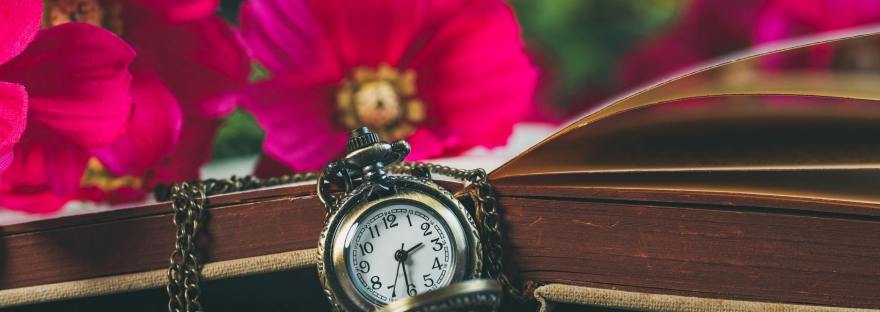
The speech I delivered in eighth grade was all about time. It even included a line from the Alan Parsons song “Time.” I had gotten the idea from helping my teacher referee basketball games. It was my job to hold the stopwatch and call out, “Time!” at the end of each period. It was less pressure than being the score keeper, that’s for sure!

That memory surfaced while brainstorming ideas for marking time in narrative. The objective is to move away from exact data measurements and dive deeper to reach the reader on an emotional level. This can apply to fiction, but can also be creatively incorporated into memoir. Sometimes using a numerical measurement just does not do enough to convey meaning. I mean, is it a story or a textbook? Yikes!
For example, “He started high school in 1997,” would be an accurate statement but falls flat. If the narrator marks the time with a scene, this same information could be told like:
My route home from school takes me by three flagpoles—my school’s, the fire hall’s, and the one in the very center of the village cemetery. As I walked home after school that autumn, these three maple leaves hung at half staff. With the stillness in the air, these flags mimicked the real maple leaves, turned from lively green to crimson red, clinging to branches of the surrounding trees. The whole world, in fact, hung at half staff. Elton John’s new rendition of “Candle in the Wind” echoed across the airwaves in dedication to England’s Rose. Being only 14 at the time, I had little concept of the impression one person could make on so many lives…
Marking a specific point in time as the above example is only the beginning of this type of exercise. How do we mark the passage of time as the plot moves? I’m reminded of seasonal cues to signal months of the year. These are handy in revealing location as well as cultural information about central characters within the narrative.
So, instead of stating, “It happened in February 1998,” the narrative could offer much more context by this account:
They adorned the hall with scarlet tigers and paper lanterns. Everyone donned their lucky red shirts and sweaters. The girls pulled their hair into princess buns and ornamented them with crimson tassels. “Gong hei fat choy,” he bellowed to his fellow pupils…
I’m reminded of a passage in Janet Burroway’s Imaginative Writing that states, “Don’t read about the period; read in the period. Read letters, journals, newspapers, magazines, books written at the time. You will in this way learn the cadences, the turn of mind and phrase, the obsessions and quirks of the period (202).” It is the writer’s job to spin a good yarn that includes all the essential threads of setting, plot, and character. Each of these elements are intricately bound and captured in time.
Reference:
Borroway, Janet. “Chapter 7: Development and Revision.” Imaginative Writing: the Elements of Craft. Toronto, Pearson, 2015.
Start the discussion by sharing your comments below. Stay tuned for my next blog post. Wanna get it in your email inbox? Subscribe to stay informed of my newest articles, story reviews, updates, and more.
Cover Image: Photo by Ylanite Koppens on Pexels.com

 Pauline Shen